

0.90 vs. 1 Carat Diamond: Is the Price Jump Worth It?
October 19, 2026
5 Best Places to Buy Yellow Gold Engagement Rings Online
November 10, 2026Best Places to Buy Pear-Cut Engagement Rings Online
Pear-shaped diamonds are a great option if you want something more distinctive than a round brilliant without sacrificing sparkle.
They also tend to look large for their carat weight because of their elongated outline.
The difficulty is that pear diamonds vary enormously.
Two stones with the same carat, color, and clarity grades can look completely different because of differences in:
- Shape
- Symmetry
- Length-to-width ratio
- Bow-tie visibility
- Facet pattern
- Face-up dimensions
That makes good imagery and individual diamond assessment especially important.
For most buyers, I would start with these four retailers:
| Retailer | Best For |
|---|---|
| Whiteflash | Quality-focused diamond selection |
| Brilliant Earth | Setting choice and design variety |
| Blue Nile | Large pear diamond inventory |
| Ritani | Price comparison |
Whiteflash: Best for a Quality-First Purchase
My first stop would be Whiteflash, particularly if you want help separating an attractive pear diamond from one that simply looks good on paper.
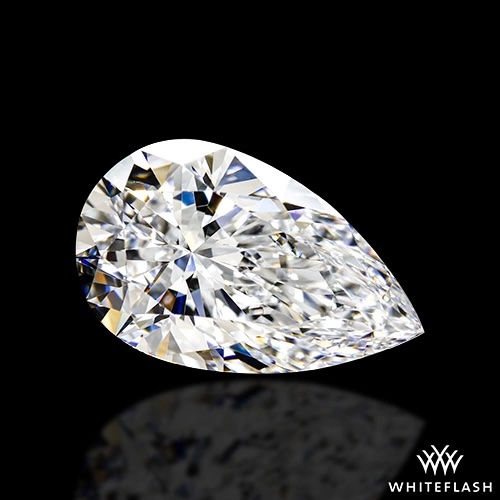
Pear shapes do not have the same straightforward cut grading system buyers can rely on with round brilliants.
Instead, you need to consider the complete appearance of the stone.
That includes whether the shoulders look balanced, how prominent the bow tie is, whether the point sits centrally, and whether the diamond carries its carat weight efficiently.
Whiteflash is a good fit for buyers who would rather evaluate a smaller number of stronger candidates than work through hundreds of similar listings.
It is also worth considering if you want a higher-end setting to complement the center stone.
What I Like
The biggest advantage is the quality-focused approach.
For a pear diamond, I would rather have useful visual information and knowledgeable guidance than another 5,000 stones added to the search results.
You can read more about the retailer in my Whiteflash review.
Brilliant Earth: Best for Ring Design
If the finished engagement ring matters just as much as the center diamond, Brilliant Earth is one of the strongest options.

The retailer offers a large selection of pear-shaped natural and lab-grown diamonds alongside a particularly broad engagement ring catalog.
You can pair a pear diamond with designs including:
- Classic solitaires
- Hidden halos
- Pavé bands
- Three-stone rings
- Vintage-inspired settings
- Nature-inspired designs
- Bezel settings
This makes Brilliant Earth especially useful if you already have a particular ring aesthetic in mind.
Its diamond imagery also helps when comparing pears with different outlines and proportions.
Best for Fancy-Shape Browsing
Pear diamonds are highly visual.
A grading report will not tell you whether one stone looks gracefully elongated while another appears too wide or bottom-heavy.
Being able to compare multiple stones visually is therefore a real advantage.
Brilliant Earth also makes sense for buyers who have not yet decided between natural and lab-grown diamonds.
My full Brilliant Earth review covers the wider shopping experience.
Blue Nile: Best for Choice
Blue Nile is the option I would look at if you want to search a very large inventory yourself.
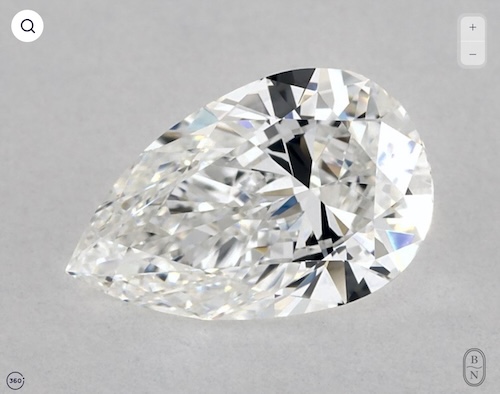
That can be particularly useful once you have narrowed your requirements.
For example, instead of browsing every pear diamond available, you might search for:
- 1.00 to 1.30 carats
- G-H color
- VS1-VS2 clarity
- Preferred length-to-width range
Then inspect the actual diamonds rather than continuing to filter by increasingly high grades.
Blue Nile’s scale gives you plenty of opportunities to find a stone with the right combination of appearance, size, and price.
Where Blue Nile Works Best
It suits buyers who are comfortable comparing diamonds independently.
Do not automatically select the highest color or clarity grade.
With pears, I would happily choose a lower-graded diamond if it had a more attractive outline, better symmetry, and a less distracting bow tie.
See my Blue Nile review for more on the retailer.
Ritani: Useful for Price Comparison
Ritani is worth adding to your search if price is particularly important.
Its large inventory can be useful for understanding what similarly graded pear diamonds are selling for elsewhere.
That does not mean the cheapest diamond is automatically the best choice.
A pear with poor symmetry or an obvious dark bow tie can still be poor value even if the certificate looks impressive.
I would use Ritani mainly as another point of comparison while narrowing down the strongest individual stones.
You can find more detail in my Ritani review.
What Makes a Good Pear-Shaped Diamond?
There is no single proportion formula that guarantees a beautiful pear.
This is one of the reasons buying purely from a grading report is risky.
Instead, look at the whole stone.
Shape and Outline
A good pear should have a smooth transition from the rounded end into the point.
Watch out for:
- Uneven shoulders
- A crooked point
- One side appearing fuller than the other
- An overly narrow appearance
- A very squat outline
The best shape is partly personal preference, but symmetry should still look convincing.
What Is the Best Length-to-Width Ratio?
A common starting range is roughly 1.45 to 1.75.
Shorter ratios produce a wider, fuller pear.
Longer ratios create a more elongated appearance.
There is no universally correct number.
One person may love a fuller 1.50 ratio while another prefers the elegance of something closer to 1.70.
Use the ratio to narrow the search, then judge the actual diamond.
Pear Diamond Bow Ties
Pear-shaped diamonds frequently show some degree of bow-tie contrast across the center.
That alone is not a reason to reject a stone.
The problem is when the bow tie becomes so dark that it dominates the appearance of the diamond.
This is something you need to assess through good imagery or video.
The grading report will not tell you whether the bow tie is attractive, moderate, or distracting.
What Color Should You Buy?
Pear diamonds can show more color toward the pointed end than round brilliants.
For many buyers, G or H provides a good balance between appearance and value.
You may prefer a higher color grade if:
- The diamond is large
- You are very sensitive to warmth
- The setting is platinum or white gold
Yellow and rose gold can make slightly warmer diamonds easier to use.
What Clarity Is Best?
There is little reason to pay extra for VVS clarity unless you specifically want the grade.
For most buyers, an eye-clean diamond is enough.
VS1 and VS2 are sensible places to start.
Some SI1 diamonds can also work well if the inclusions are not visible without magnification and do not create durability concerns.
The inclusion location matters just as much as the grade.
Natural or Lab-Grown?
Both are widely available in pear shapes.
A natural pear diamond costs considerably more because of its natural origin and rarity.
Lab-grown diamonds make larger carat weights much more accessible.
That makes pear shapes particularly interesting in lab-grown form because the elongated outline already creates strong finger coverage.
The decision ultimately comes down to whether you place more importance on natural origin or maximizing size for the budget.
Best Settings for Pear-Cut Engagement Rings
The setting should protect the pointed end of the diamond.
Solitaire
Probably the best option if you want the pear shape itself to remain the focus.
Hidden Halo
Adds extra sparkle from the side without changing the face-up outline dramatically.
Three-Stone
Pear diamonds pair especially well with tapered baguettes, round diamonds, or smaller pears.
Halo
A halo can substantially increase the visual presence of the ring.
Just make sure it follows the pear outline cleanly.
Bezel
A modern option that offers additional protection around the diamond.
Which Retailer Should You Choose?
If I were narrowing the search today, I would approach it like this:
Whiteflash would be my first choice if diamond quality and expert evaluation were the priorities.
Brilliant Earth would be particularly appealing if I wanted lots of engagement ring styles and a wide pear diamond selection.
Blue Nile would be useful if I wanted to search a very large inventory myself.
Ritani would be part of the comparison if price was a major consideration.
The retailer matters, but with pear-shaped diamonds the individual stone matters even more.
Do not choose one because the certificate has the highest grades.
Choose the pear with the most attractive shape, balanced symmetry, pleasing facet pattern, sensible spread, and a bow tie that does not overwhelm the diamond.
Frequently Asked Questions
Are pear-shaped diamonds good for engagement rings?
Yes. They offer strong brilliance, an elongated appearance, and excellent finger coverage.
Do pear diamonds look bigger than round diamonds?
They often appear larger because their elongated shape covers more of the finger.
Are pear diamonds less expensive than round diamonds?
They can be less expensive per carat than comparable round brilliants.
Is a bow tie normal?
Yes. Some contrast is common in pear diamonds. The key is avoiding a bow tie that looks excessively dark or distracting.
Should the point face up or down?
Traditionally the point faces toward the fingertip, but this is purely a style choice.
What is the best place to buy a pear-cut engagement ring online?
I would start with Whiteflash for a quality-focused purchase, followed by Brilliant Earth for design choice and Blue Nile for inventory.
Final Thoughts
Pear diamonds reward careful shopping.
You cannot reduce the decision to color, clarity, and carat weight.
The outline, symmetry, bow tie, proportions, and visual character of the diamond all matter.
That is why strong imagery and individual assessment are so important.
A beautifully shaped G VS2 pear can easily be a better purchase than a D VVS diamond with an awkward outline or distracting bow tie.
For this shape in particular, buy the diamond you like looking at, not the certificate with the most impressive grades.
