

A Guide to Buying a 3/4 Carat Diamond
August 7, 2026
The Best Places to Buy Yellow Gold Jewelry Online in 2026
September 9, 2026What Size Diamond Can You Buy for $5,000? Natural vs. Lab-Grown
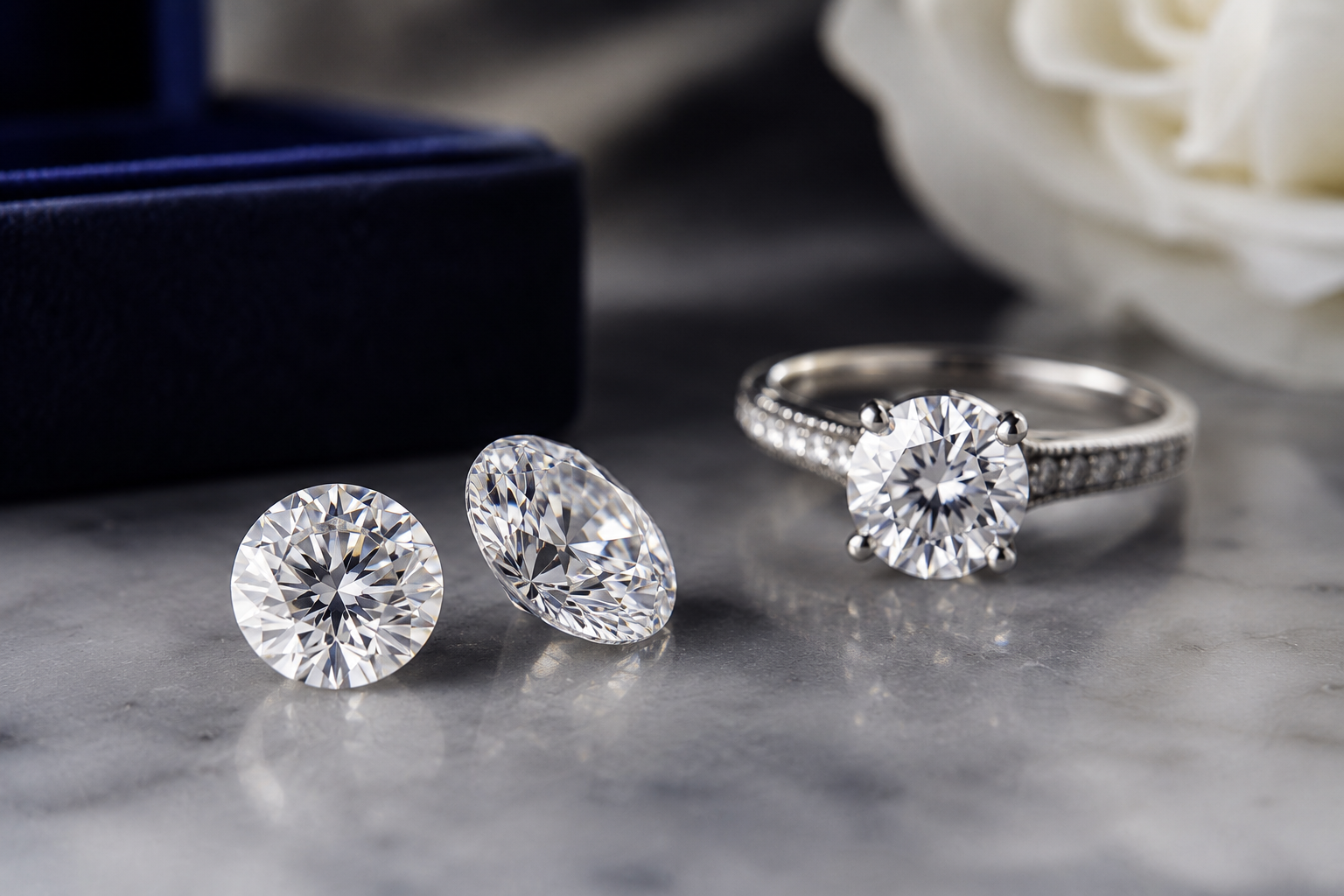
If you have $5,000 to spend on a diamond, how big can you realistically go?
The short answer is approximately 1 to 1.25 carats for a good-quality natural diamond, while the same budget can comfortably put you into the 2.5 to 3+ carat range for a lab-grown diamond.
But that answer needs a very large asterisk.
Diamond quality is a huge factor in determining price.
Two diamonds with exactly the same carat weight can differ in price by thousands of dollars because of differences in cut quality, color, clarity, certification, shape, proportions, fluorescence, and overall visual performance.
In fact, current inventory demonstrates just how wide the variation can be. At the time of writing, Ritani lists a 1.20 carat G VS2 GIA-certified natural round for $4,676, while Whiteflash lists a premium 1.24 carat G VS1 A CUT ABOVE® natural diamond for $7,995. The difference is not simply 0.04 carats. You are comparing diamonds with different quality standards and propositions.
That is why I never recommend beginning a diamond search with carat weight alone.
The Quick Answer: What Does $5,000 Buy?
If the entire $5,000 is being spent on the loose center diamond, these are sensible starting expectations:
| Diamond Type | Approximate Size for $5,000 | What I Would Target |
|---|---|---|
| Natural round | 1.00-1.25 ct | Excellent cut, G-I color, VS2-SI1 clarity |
| Natural oval/pear/radiant | 1.10-1.40 ct | Strong proportions and eye-clean clarity |
| Premium super ideal natural | Around 0.80-1.00+ ct | Exceptional cut and light performance |
| Lab-grown round | 2.5-3.5+ ct | Excellent/Ideal cut, strong color and clarity |
| Lab-grown fancy shape | 3.0 ct+ | Carefully selected proportions and appearance |
These ranges are deliberately broad.
Current market inventory shows that even diamonds with similar headline specifications can vary considerably in price. Ritani, for example, currently lists a 1.20 carat G VS2 Ideal round natural diamond for $4,676, while Blue Nile currently has 1 carat G/H VS2 natural rounds around the $3,000 level.
Lab-grown pricing is dramatically different. Blue Nile currently lists 3 carat lab-grown round diamonds around $3,390, while Brilliant Earth has numerous 3 carat lab-grown diamonds starting below $2,000 depending on their specifications.
The takeaway is simple:
$5,000 does not buy a specific diamond size. It buys a combination of size and quality.
Before continuing, I recommend reading my guides to diamond carat weight and diamond pricing, as they explain why carat weight and price do not increase in a simple straight line.
What Natural Diamond Can You Buy for $5,000?
For a natural diamond, I would typically begin a $5,000 search somewhere around 1 to 1.25 carats.
You could potentially go larger.
However, simply finding the biggest diamond under $5,000 is not the objective.
As carat weight increases, something usually has to give. That could mean:
- Lower color
- Lower clarity
- Inferior cut
- Less desirable proportions
- Noticeable inclusions
- Stronger fluorescence
- A less prestigious grading report
- A deeper stone that carries weight without looking larger
This is where buyers can get into trouble.
A 1.40 carat diamond offered at an unusually low price may sound better than a beautiful 1.10 carat alternative, but the heavier stone is not automatically the better purchase.
Quality Is More Important Than the Number on the Scale
Carat measures weight, not beauty.
It does not tell you how bright the diamond will be, how much it will sparkle, whether it is eye clean, how white it appears, or even how large it will look from the top.
A diamond with poor proportions can carry excess weight in its depth. You are technically paying for that additional carat weight, but you may barely see it once the diamond is mounted.
This is why diamond cut is one of the first things I assess.
For round diamonds in particular, cut quality has an enormous influence on brightness, fire, scintillation, and overall visual impact. Whiteflash makes the same point in its current diamond education material, noting that a smaller diamond cut to ideal proportions can outperform a larger diamond with poorer proportions.
If spending $5,000, I would rather own an outstanding 1.05 carat diamond than a mediocre 1.30 carat diamond.
A Good $5,000 Natural Diamond Target
For someone looking for a round natural diamond, I would begin with something around:
Carat: 1.00-1.20 ct
Cut: Excellent/Ideal, with cut quality prioritized above everything else
Color: G-I
Clarity: VS2 or carefully selected eye-clean SI1
Certification: Preferably GIA
Polish: Excellent
Symmetry: Excellent
Fluorescence: Assess individually
These are starting specifications rather than hard rules.
Dropping from G to H color, for example, may allow you to increase carat weight without producing an obvious visual difference.
Similarly, paying for VVS clarity is often unnecessary if a VS2 diamond is completely eye clean.
You can learn more about striking this balance in my guides to diamond color and diamond clarity.
Live Natural Diamond Example: Ritani
Here is a good demonstration of what approximately $5,000 can currently buy.
At the time of writing, Ritani has a:
1.20 carat round natural diamond
G color
VS2 clarity
Ideal cut
GIA certified
Price: $4,676
View the 1.20 carat Ritani diamond
Ritani describes the diamond as eye clean with excellent sparkle, faint fluorescence, and a visual spread larger than average for its weight. Its measurements are also important because they tell us how effectively that 1.20 carats is presenting from the top.
This is much more useful information than simply seeing “1.20 carats.”
Prices and inventory checked August 10, 2026. Individual diamonds can sell at any time.
Could You Get a Bigger Natural Diamond?
Potentially, particularly if you choose a fancy shape.
Round brilliant diamonds tend to command higher prices, in part because cutting a round diamond results in greater loss of the original rough material. Blue Nile currently notes that round diamonds become increasingly expensive relative to fancy shapes as carat weight increases.
Shapes worth considering include:
- Oval
- Pear
- Marquise
- Radiant
- Cushion
- Emerald
Some also offer greater visual spread.
An elongated oval, pear, or marquise may look noticeably larger on the finger than a round diamond of the same weight.
At the time of writing, for example, Ritani lists a 1.20 carat G VS2 natural oval for $4,912.
Read my diamond shapes guide before deciding purely on carat weight.
What Lab-Grown Diamond Can You Buy for $5,000?
This is where the numbers change dramatically.
If your $5,000 is being spent on a loose lab-grown diamond, 3 carats becomes completely realistic.
Depending on shape, specifications, retailer, and production quality, you could potentially go larger still.
However, the same warning applies:
Do not confuse a bigger lab-grown diamond with a better lab-grown diamond.
Lab-grown diamond pricing has become extremely competitive. As a result, chasing maximum carat weight is easy, but I would still focus on:
- Cut quality
- Proportions
- Light performance
- Transparency
- Growth quality
- Strain or other optical issues
- Color
- Clarity
- Certification
- Quality of imaging
Read my full guide to lab-grown diamond pricing and my article on whether you should buy a lab-grown diamond for more background.
Live Lab-Grown Diamond Example: Blue Nile
At the time of writing, Blue Nile has a particularly useful example:
3.25 carat round lab-grown diamond
G color
VS1 clarity
Excellent proportions
GIA grading report
Price: $3,257
View the 3.25 carat Blue Nile lab-grown diamond
That leaves well over $1,500 of a $5,000 budget available for a setting.
This illustrates just how different the size proposition becomes when you choose lab-grown.
Again, it does not mean this particular diamond is automatically better than every smaller option. The diamond itself still needs to be evaluated.
Price and availability checked August 10, 2026.
Live Lab-Grown Diamond Example: Whiteflash
Whiteflash takes a slightly different approach to lab-grown diamonds, focusing heavily on precision cutting and quality rather than simply competing on maximum carat weight.
At the time of writing, its Precision Lab inventory includes a:
2.26 carat oval lab-grown diamond
E color
VVS2 clarity
GIA certified
Price: $2,300
View the 2.26 carat Whiteflash Precision Lab diamond
Whiteflash provides detailed analysis and imaging of its in-house diamonds, and its Precision Lab range follows the company’s broader performance-first approach.
This is a useful reminder that even within lab-grown diamonds, you may decide to spend your money on quality rather than maximum size.
A beautifully cut 2.25 carat diamond may be a much smarter purchase than an average-quality 3.5 carat stone.
Price and availability checked August 10, 2026.
Live Lab-Grown Diamond Examples: Brilliant Earth
Brilliant Earth also demonstrates how far a $5,000 lab-grown budget can stretch.
At the time of writing, its inventory includes examples such as:
- 2.98 ct Oval, E color, VS1, Super Ideal: $3,950
- 3.02 ct Round, H color, VS1, Super Ideal: $4,090
- 2.91 ct Round, G color, VVS2, Super Ideal: $3,220
- 2.59 ct Cushion, F color, VS1, Super Ideal: $4,440
Browse Brilliant Earth’s lab-grown diamonds
These examples show why simply saying “$5,000 buys a 3 carat lab diamond” is overly simplistic. Changing color, clarity, shape, and other quality characteristics can alter the price significantly even when the carat weight stays relatively similar.
Inventory checked August 10, 2026.
Natural vs. Lab-Grown: $5,000 Compared
A realistic comparison looks something like this:
| Natural Diamond | Lab-Grown Diamond | |
|---|---|---|
| Typical target | Around 1.0-1.25 ct | Around 2.5-3.5+ ct |
| $5,000 enough for 1 ct? | Yes | Easily |
| $5,000 enough for 2 ct? | Usually difficult at desirable quality | Yes |
| $5,000 enough for 3 ct? | No at the quality I would recommend | Yes |
| Priority | Balance rarity, quality, and size | Avoid chasing size at expense of quality |
| Resale/value profile | Generally stronger | Typically much weaker |
| Best reason to choose | Natural origin and rarity | Maximum size and specifications for your budget |
Lab-grown diamonds offer significantly more carat weight for the money. Current retailer pricing makes that very clear.
But that does not automatically make lab-grown the better choice.
Your decision should depend on what you value.
If owning a naturally formed diamond matters to you, then I would focus on finding the best-performing natural diamond your $5,000 budget allows.
If you care primarily about visual impact and want a 2.5, 3, or even larger center stone without dramatically increasing your budget, lab-grown becomes extremely compelling.
Don’t Overspend on Color and Clarity
One of the easiest ways to waste a $5,000 diamond budget is paying for quality grades that you cannot actually see.
Color
D color is technically higher than G or H, but that does not necessarily mean it is a better purchase for you.
Near-colorless diamonds can appear beautifully white, particularly when well cut.
Dropping a couple of color grades may allow you to:
- Increase carat weight
- Improve cut
- Choose a better setting
- Simply spend less
Clarity
The same principle applies to clarity.
A VVS1 diamond contains fewer or harder-to-see inclusions than a VS2, but if both look completely clean without magnification, the VVS premium might give you very little visible benefit.
This is why I frequently recommend VS2 as a starting point, adjusting up or down depending on the individual diamond.
Learn more in my diamond clarity guide.
Cut Is Where I Would Spend the Money
If there is one area where I would be reluctant to compromise, it is cut.
Cut quality determines how effectively a diamond handles light.
A well-cut diamond can appear:
- Brighter
- More fiery
- More lively
- Larger
- More visually impressive
Poor cutting can make an expensive diamond appear dull.
This becomes especially important when trying to maximize a fixed $5,000 budget.
Whiteflash is particularly useful for buyers who want to take this approach. Its A CUT ABOVE® natural diamonds are selected around strict light-performance and precision-cutting standards, while its Precision Lab range applies a similar quality-led philosophy to lab-grown diamonds. Whiteflash publishes ASET, IdealScope, hearts-and-arrows imagery, HD video, and grading information for its in-house round diamonds.
That level of information can be more valuable than simply filtering a database by carat, color, and clarity.
A Great Example of Why Quality Changes Price
Consider two natural diamonds.
A current Ritani listing offers:
1.20 ct / G / VS2 / Ideal Round: $4,676.
Meanwhile, Whiteflash currently lists:
1.24 ct / G / VS1 / A CUT ABOVE® Round: $7,995.
They are only 0.04 carats apart.
Yet there is a difference of more than $3,000 in asking price.
Why?
Because carat is only one component of diamond value.
The Whiteflash diamond sits within a premium super ideal cut category with extensive light-performance analysis and a higher clarity grade. The Ritani example represents a different proposition.
Neither price can be explained by carat weight alone.
This is perhaps the most important lesson in this entire guide.
What If the $5,000 Has to Include the Setting?
So far, I have treated $5,000 as your diamond budget.
If $5,000 needs to cover the entire engagement ring, you need to reserve part of it for the setting.
A straightforward solitaire might leave the majority of your budget available for the center diamond, while pavé, halo, three-stone, designer, or platinum settings can take a much larger percentage.
For a natural diamond, I might therefore reduce the center-stone target toward approximately 0.90 to 1.10 carats depending on the setting.
For lab-grown, a 2 to 3 carat center stone should still be extremely achievable with a $5,000 total budget based on current inventory. Current Ritani guidance similarly places a $5,000 engagement-ring budget around 1.5-2 carats for lab-grown, compared with roughly 0.75 carats natural when the whole ring is being considered.
I have also written a dedicated $5,000 diamond ring buying guide that goes into this question in more detail.
Where Should You Shop With a $5,000 Budget?
Whiteflash: Best for Cut Quality
Whiteflash would be my first choice if quality and particularly cut performance are your priorities.
You may get less carat weight for your $5,000 than you would by simply choosing the cheapest diamond in a massive virtual inventory, but that misses the point.
For a natural diamond, I would investigate its A CUT ABOVE® and Expert Selection inventories.
For lab-grown, its Precision Lab range is particularly attractive for buyers who want a larger diamond without abandoning a quality-first approach.
Blue Nile: Best for Selection
Blue Nile is excellent for seeing exactly what your budget can achieve across a massive inventory.
At the time of writing, its natural round inventory includes 1 carat G/H VS2 diamonds around the $3,000 range, while 3 carat lab-grown rounds can be found in the mid-$3,000s.
That makes it particularly useful for comparing what happens when you change one variable at a time.
Ritani: Best for Value Comparison
Ritani is worth checking if you are trying to stretch $5,000 as far as possible.
Its current inventory demonstrates that approximately 1.2 carats is realistic for a good-quality natural diamond within this budget, and its site provides unusually detailed pricing information on many diamonds.
Brilliant Earth: Best for Lab-Grown Choice and Settings
Read my Brilliant Earth review.
Brilliant Earth’s large lab-grown offering makes it easy to compare 2, 2.5, and 3+ carat stones while staying comfortably below $5,000.
It is also worth considering if setting design is a major part of your decision.
Tiffany & Co.: Best for Brand Prestige
Tiffany is a different proposition.
If your objective is maximizing the size of the diamond you receive for $5,000, it would not be my first choice. Part of what you are paying for is the Tiffany brand, craftsmanship, presentation, heritage, and retail experience.
For someone who specifically wants a Tiffany engagement ring, those things may be worth the premium.
For someone primarily asking, “How much diamond can I get for $5,000?” I would concentrate on specialist diamond retailers instead.
How I Would Spend $5,000
If I wanted a natural diamond, I would search somewhere around:
1.00-1.20 carats
Excellent/Ideal cut
G-I color
VS2-SI1 clarity
GIA graded
I would then assess each diamond individually rather than automatically selecting the biggest.
If I wanted lab-grown, I would probably search around:
2.25-3.00 carats
Excellent/Ideal cut
D-H color
VS1-VS2 clarity
Why stop at 3 carats when larger stones may be available within $5,000?
Because I would rather put the money into getting the cut, proportions, optical quality, and overall appearance right than simply chase the largest possible number.
A $5,000 budget is already enough to buy a very substantial lab-grown diamond.
There is no need to sacrifice quality just to say you bought 4 carats.
Final Verdict: How Big a Diamond Does $5,000 Buy?
For a natural diamond, a budget of $5,000 puts approximately 1 to 1.25 carats firmly within reach if you balance the 4Cs carefully. Fancy shapes and slightly lower color or clarity grades may allow you to go somewhat larger.
For a lab-grown diamond, the same budget can realistically buy a 2.5 to 3+ carat stone, with current examples showing that high-specification diamonds around 3 carats can cost considerably less than $5,000.
But I would not make carat weight the goal.
Quality is a huge factor in determining diamond price, and it should also be a huge factor in determining what you buy.
A $5,000 natural diamond could be a premium sub-1 carat stone, an excellent 1.1-1.2 carat stone, or a significantly larger diamond with compromises elsewhere.
Likewise, a $5,000 lab-grown budget could buy an exceptional 2-2.5 carat diamond or be pushed toward a much larger stone.
My approach is simple:
Choose your quality threshold first, then buy as much carat weight as your budget allows.
For natural diamonds, I would start with Whiteflash if cut quality is the priority, then compare the broader inventory at Blue Nile and Ritani.
For lab-grown diamonds, Whiteflash offers a particularly quality-focused proposition, while Blue Nile and Brilliant Earth provide extensive selections at a wide variety of sizes and price points.
And remember: the best $5,000 diamond is not necessarily the biggest one. It is the one that gives you the best combination of size, beauty, and quality for the things you actually notice.
