5 Best Places to Buy Three-Stone Engagement Rings
July 17, 2026
A Guide to Buying a 3/4 Carat Diamond
August 7, 2026Can You Put a Bigger Diamond in an Existing Engagement Ring?
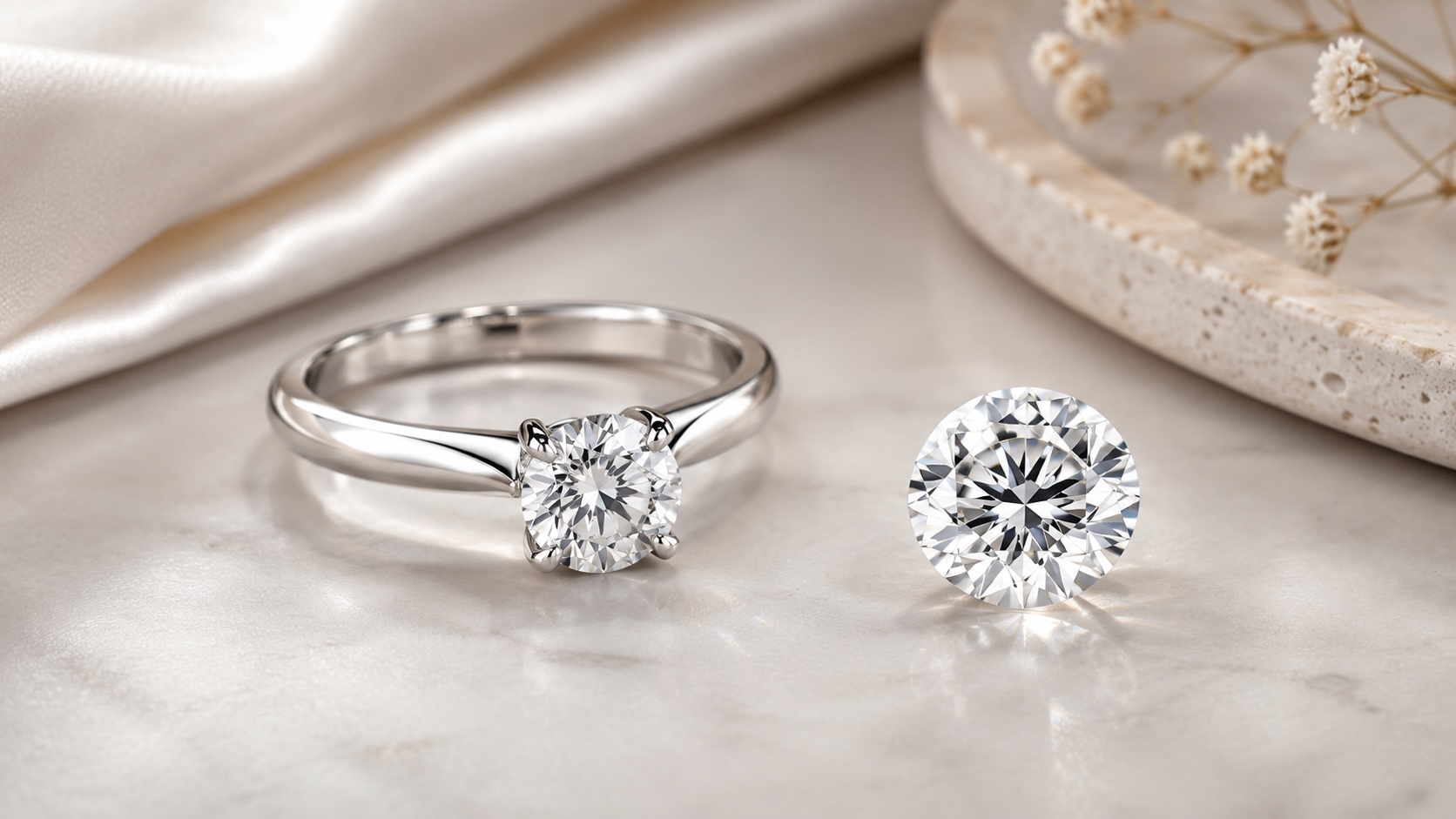
Yes, you can often put a bigger diamond in an existing engagement ring, but it depends on the design, condition, and construction of the setting.
A small increase in diamond size may only require the prongs to be adjusted or replaced. A more significant upgrade could require a new basket, head, or entirely new setting. Designs such as solitaires are usually easier to modify, while bezel, halo, pavé, and tension settings tend to offer less flexibility.
The most important step is having the ring inspected by an experienced jeweler before buying the replacement diamond. The jeweler needs to assess the ring and provide a suitable range of diamond measurements, not simply a maximum carat weight.
Can an Existing Engagement Ring Hold a Larger Diamond?
Many engagement rings can accommodate a larger center diamond, particularly when the ring uses a traditional prong setting.
However, the new diamond must fit securely within the structural limits of the ring. The jeweler will usually examine:
- The dimensions and shape of the current diamond
- The length, thickness, and position of the prongs
- The size and construction of the basket or head
- The width and strength of the band
- The placement of any accent diamonds
- The age and condition of the metal
- The overall balance of the finished ring
The different parts of a ring work together to support and protect the center stone. Our guide to engagement ring settings explains how prong, bezel, halo, tension, cathedral, and other settings hold a diamond.
In some cases, a jeweler can modify the existing head. In others, replacing the head provides a more secure and visually balanced result. If neither option is practical, the original setting may need to be replaced.
Carat Weight Is Not the Same as Diamond Size
One of the biggest mistakes people make is assuming that carat weight tells a jeweler whether a diamond will fit.
Carat is a measurement of weight. The physical size of the diamond is determined by its millimeter measurements, shape, proportions, and depth.
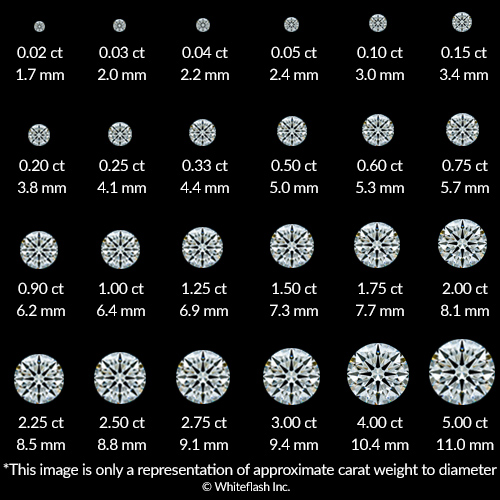
Image courtesy Whiteflash.com
Two diamonds with the same carat weight can face up at noticeably different sizes. For example, a deeply cut diamond may carry more of its weight below the setting, while a well-proportioned or shallower diamond may appear wider when viewed from above.
The jeweler will normally need the following measurements:
- Length
- Width
- Total depth
- Girdle thickness
- Shape and outline
This is why you should obtain the jeweler’s recommended measurement range before buying a replacement stone. Asking whether the setting can hold “a 1.5 carat diamond” is less useful than asking whether it can safely hold a round diamond measuring approximately 7.3 mm across.
You can learn more about the relationship between visible size and carat weight in our guide to the average engagement ring size.
How Much Bigger Can You Go?
There is no universal limit because engagement ring settings are not all constructed in the same way.
A modest increase may be possible without substantially changing the ring. For example, moving from a 0.75 carat round diamond to a carefully selected stone near 1 carat may be possible in some solitaire settings. That does not mean every setting can accommodate the change.
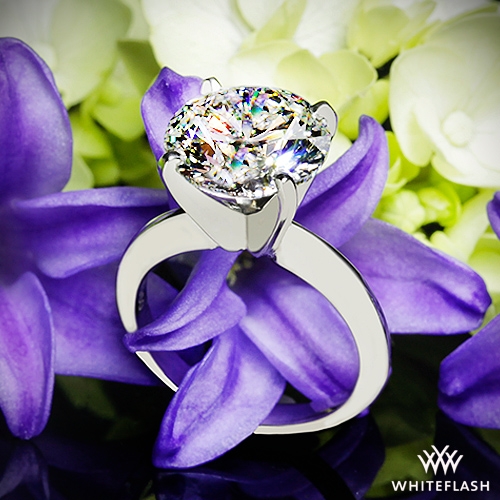
4.205 Carat Diamond Engagement Ring from Whiteflash
A larger jump, such as moving from 1 carat to 2 carats, will normally require more extensive work. The existing prongs and basket are unlikely to have been designed to support a diamond with significantly larger dimensions.
The ring may need:
- Longer or repositioned prongs
- A larger basket
- A replacement head
- Additional metalwork around the shoulders
- Changes to the height of the center stone
- Reinforcement to support the additional weight
- A completely new setting
Trying to force an oversized diamond into an unsuitable head can leave the stone poorly supported. It may also create an unattractive result in which the diamond looks disproportionately large compared with the band and accent stones.
Which Ring Settings Are Easiest to Upgrade?
The design of the ring will have a major influence on how easily the center diamond can be replaced.
| Setting | Upgrade difficulty | What to consider |
|---|---|---|
| Prong solitaire | Usually easiest | The head or prongs may be replaceable without changing the band |
| Peg-head solitaire | Usually straightforward | The separate head can often be removed and replaced |
| Cathedral setting | Moderate | The new head must align correctly with the raised shoulders |
| Three-stone ring | Moderate to difficult | The center and side stones must remain proportionate |
| Halo setting | Difficult | The halo is normally made for a specific center-stone outline |
| Bezel setting | Difficult | The surrounding metal must closely match the diamond’s dimensions |
| Pavé ring | Difficult | Alterations may disturb small diamonds set into the band |
| Tension setting | Very difficult | The entire ring is engineered around the original diamond |
| Vintage or antique ring | Varies | Older metal, delicate details, and previous repairs may restrict alterations |
Solitaire Settings
A traditional solitaire is generally the easiest engagement ring to upgrade. There are no surrounding diamonds that must match the dimensions of the new stone, and the center head may be replaceable.
A peg-head solitaire can be particularly flexible because the component holding the diamond is attached separately to the band. A jeweler may be able to remove the original head and install one designed for the new diamond.
Cathedral Settings
A cathedral engagement ring uses raised shoulders that sweep upward toward the center diamond. These shoulders can make the stone appear more prominent, but they also create fixed points around the head.
A replacement head must sit naturally between the shoulders. A head that is too wide, narrow, high, or low can disrupt the appearance of the ring.
Halo Settings
Halo settings are usually built around the exact shape and dimensions of the center diamond. Increasing the size of the center stone may reduce or remove the space between the diamond and the halo.
A jeweler might be able to make a very small adjustment, but a meaningful increase will normally require a new halo or setting. Rebuilding the existing halo can sometimes cost enough that purchasing a new setting becomes the better option.
Bezel Settings
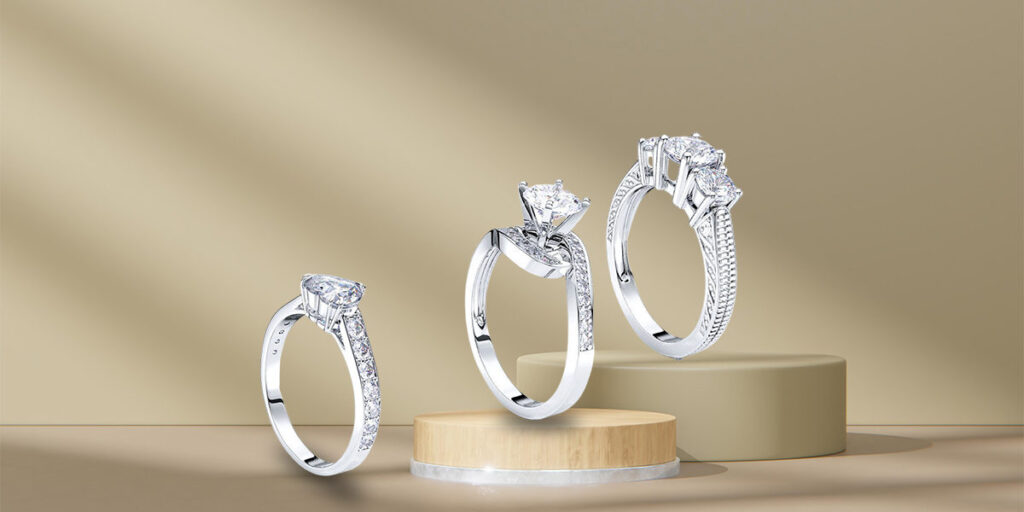
A bezel surrounds the diamond with a fitted rim of metal. Because the bezel is formed around the stone, it cannot simply be opened to accept a much larger diamond.
The bezel will normally need to be rebuilt. Altering it may also change the profile and finish of the ring.
Pavé Settings
Pavé diamonds can make an engagement ring look brighter and more detailed, but they also make modifications more complicated. Cutting, heating, bending, or reshaping the ring can loosen the small diamonds set into the band.
Our guide to pavé engagement rings explains why these settings require particularly careful maintenance and alteration.
Tension Settings
A tension setting uses precisely calculated pressure to hold the diamond between two sides of the ring. Its structure is engineered for a specific diamond size and shape.
Replacing the original stone with a larger one will usually require the ring to be remade rather than adjusted.
Can You Change the Diamond Shape?
Changing to a larger diamond in the same shape is normally easier than changing both the size and shape.
A round diamond cannot usually be placed into a head made for an oval, princess, pear, or marquise diamond. Each shape requires prongs to be positioned around particular corners and vulnerable points.
A shape change will usually require a replacement head or a new setting. This can still be worthwhile when the band has sentimental value.
Common shape changes include:
- Round to oval for greater finger coverage
- Round to cushion for a softer square appearance
- Princess to round to remove exposed corners
- Round to emerald for a longer, more understated look
- Round to pear or marquise for a distinctive elongated profile
Elongated shapes can appear larger than some round diamonds of comparable carat weight because they cover more of the finger. However, visual size should never come at the expense of cut quality, proportions, or durability.
Should You Keep the Setting or Buy a New One?
Keeping the existing setting makes sense when:
- It has strong sentimental value
- The metal remains in good condition
- The design can safely support the larger diamond
- The new stone is only moderately larger
- The setting still suits your taste and lifestyle
- Alteration costs are reasonable
A new setting may be the better choice when:
- The new diamond is substantially larger
- The prongs or band are heavily worn
- The setting has already been repaired several times
- The halo or bezel was made for the original stone
- The new diamond has a different shape
- The existing band looks too narrow or delicate
- The alteration would cost almost as much as a new setting
- You want to change the metal, design, or overall style
A new setting does not necessarily mean abandoning the original ring. The old setting can be preserved, redesigned, or used with another gemstone.
Read our guide to choosing an engagement ring setting before deciding whether to modify or replace the existing design.
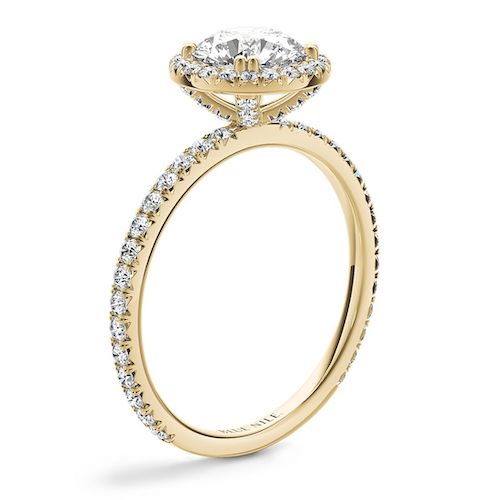
Blue Nile Studio Heiress Halo Diamond Engagement Ring from Blue Nile
Where to Shop for an Upgrade Diamond
Finding the right replacement diamond is about more than increasing the carat weight.
Whiteflash is my preferred choice when cut quality, consistency, and light performance are the priorities. Its in-house diamonds are carefully vetted and supported by detailed imaging, making it easier to find a diamond that delivers excellent beauty and value rather than simply more weight.
Blue Nile is particularly useful when you want to compare a large selection of diamond shapes, carat weights, colors, and clarity grades.
Brilliant Earth is worth considering for shoppers interested in eco-conscious jewelry, responsibly sourced options, and a broad selection of lab-grown diamonds.
Do Not Sacrifice Cut Quality for Carat Weight
A bigger diamond is not automatically a more beautiful diamond.
Cut quality determines how effectively the stone handles light. A well-cut diamond can look brighter, livelier, and sometimes visually larger than a heavier diamond with weaker proportions.
When comparing upgrade options, consider:
- Cut quality and proportions
- Light return
- Face-up measurements
- Symmetry
- Color
- Eye-clean clarity
- Certification
- Durability
- How the diamond looks in different lighting
This is particularly important when buying online. High-resolution video can help you examine clarity and shape, while specialist diamond imaging such as ASET and IdealScope images can reveal how effectively a diamond returns light.
Do not assume that a laboratory report alone guarantees a beautiful stone. The report should be used alongside images, videos, measurements, and expert assessment.
Check the Diamond Certification
The replacement diamond should come with an independent grading report from a respected laboratory.
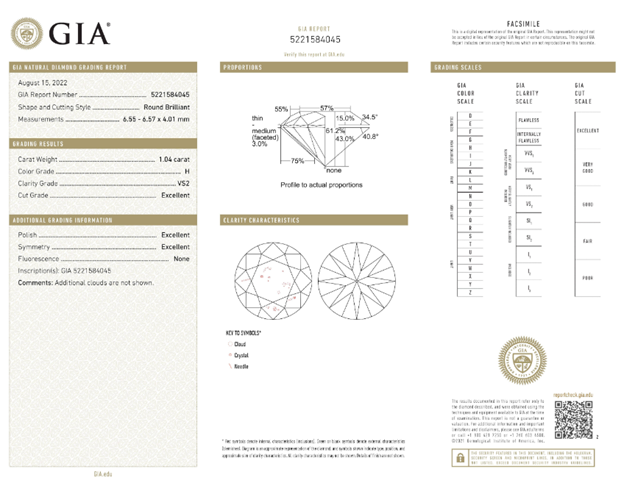 A grading report confirms important characteristics such as:
- Whether the diamond is natural or lab-grown
- Carat weight
- Color
- Clarity
- Measurements
- Proportions
- Polish
- Symmetry
- Fluorescence
- Identifying inclusions
For natural diamonds, the Gemological Institute of America remains one of the most widely recognized grading authorities. IGI reports are particularly common within the lab-grown market.
Our complete guide to diamond certification explains the differences between the major grading laboratories and why the report matters.
Natural or Lab-Grown for a Diamond Upgrade?
A lab-grown diamond can allow you to purchase a substantially larger stone without the price associated with a comparable natural diamond.
Lab-grown diamonds have the same fundamental crystal structure and optical properties as natural diamonds, but they are created in controlled environments rather than formed underground. They are especially attractive to shoppers who prioritize size, design, and initial purchase price.
However, natural and lab-grown diamonds behave differently in the resale market. Lab-grown diamond prices have fallen considerably as production has expanded, and their resale values tend to be limited.
Before choosing, read:
- Should you buy a lab-grown diamond?
- Lab-grown diamond pricing
- Are lab-grown diamonds worth anything?
A lab-grown diamond can be an excellent choice when your main goal is obtaining a larger, attractive stone for your budget. A natural diamond may be preferable when rarity, long-term ownership, and potential upgrade programs matter more.
Consider the Color of the Existing Accent Diamonds
If the engagement ring contains side stones, a halo, or pavé diamonds, the new center diamond needs to look appropriate beside them.
A center diamond with a noticeably warmer or cooler appearance may draw attention to differences in color. This does not mean every stone must have an identical grade, but they should look harmonious when viewed together.
The setting metal also affects the appearance of color:
- Platinum and white gold can make warmth more noticeable
- Yellow gold can complement diamonds with slightly warmer color
- Rose gold adds warmth across the entire design
- Yellow or rose-gold prongs can reflect color into the diamond
Ask the jeweler to compare the proposed center stone with the accent diamonds before setting it.
Will a Bigger Diamond Sit Higher?
Possibly. A larger diamond may need a wider or deeper basket, which can change the height of the ring.
A high setting creates more space around the diamond and can give it a prominent appearance. It can also make the ring more likely to catch on clothing or receive accidental knocks.
Consider how the new height will affect:
- Comfort
- Everyday wear
- Work and hobbies
- Glove use
- The wedding band
- The risk of snagging
- Cleaning and maintenance
A low-profile setting may be more practical for an active lifestyle, but the basket still needs enough space to protect the diamond and allow a wedding band to sit as intended.
Will the Existing Wedding Band Still Fit?
Changing the center head can alter how the engagement ring sits beside the wedding band.
A wider basket or lower setting may prevent a straight wedding band from sitting flush. A larger diamond can also extend farther across the finger and visually overwhelm a delicate wedding ring.
Before approving the work, take both rings to the jeweler and ask to see how the completed engagement ring is expected to sit beside the band.
In some cases, a curved, contoured, or notched wedding band may be required.
How Much Does It Cost to Put a Bigger Diamond in a Ring?
The total cost can include much more than the price of the new diamond.
Potential expenses include:
- Removing the original stone
- Inspecting and cleaning the setting
- Adjusting or retipping the prongs
- Replacing the head or basket
- Rebuilding a bezel or halo
- Repairing worn metal
- Replacing loose accent diamonds
- Setting and securing the new diamond
- Refinishing and polishing the ring
- Updating the appraisal
- Increasing the insurance coverage
A simple prong adjustment will cost less than replacing a head or rebuilding a custom halo. Precious metal, design complexity, diamond shape, and the condition of the ring will all affect the quote.
Ask for a complete written estimate before authorizing the work. Compare the cost of modifying the ring with the cost of buying a suitable new setting.
For more ways to allocate your spending effectively, read our guide to buying an engagement ring on a budget.
What Should You Do With the Original Diamond?
Replacing the center stone leaves you with several options for the original diamond.
You could:
- Set it into a pendant
- Use it in a right-hand ring
- Add it to a three-stone design
- Use it as part of an anniversary ring
- Save it as a family heirloom
- Pass it down to a child
- Trade it toward the new diamond
- Sell it independently
Resetting the original diamond is often the most sentimental option. A pendant allows you to continue wearing the stone without competing with the upgraded engagement ring.
Selling or trading the diamond may help fund the upgrade, but the amount offered will usually be lower than the original retail price. Our guide to selling a diamond ring explains the available options.
Check Whether You Have an Upgrade Program
The retailer that sold the original diamond may offer a trade-up or upgrade program.
Under an upgrade program, the retailer may provide credit based on the original diamond’s purchase price when you buy a more expensive stone. Requirements can include:
- Returning the original grading report
- Keeping the diamond in undamaged condition
- Choosing a new diamond above a minimum price
- Purchasing from the same retailer
- Meeting restrictions based on diamond type or collection
- Paying for a new setting or setting alterations separately
Policies change, so confirm the current terms directly with the retailer rather than relying on the conditions that applied when the ring was purchased.
Our comparison of diamond trade-up and upgrade programs provides a useful starting point.
Choose a Retailer Based on Your Priorities
For exceptional cut and light performance: Start with Whiteflash. Its focus on carefully vetted, precision-cut diamonds makes it a strong choice when you want the upgrade to improve sparkle as well as size. Read my full Whiteflash review.
For the widest choice: Browse Blue Nile. Its large inventory makes it easier to compare carat weights, shapes, colors, clarity grades, and prices. Read my Blue Nile review.
For eco-conscious and lab-grown options: Consider Brilliant Earth. It offers a wide range of lab-grown diamonds, modern settings, and sustainability-focused collections. Read my Brilliant Earth review.
How the Upgrade Process Usually Works
The process should begin with the ring rather than the new diamond.
1. Have the Ring Inspected
Ask a qualified jeweler to examine the prongs, head, band, solder joints, accent stones, and overall metal condition.
2. Obtain a Suitable Measurement Range
The jeweler should tell you which diamond shapes and dimensions can safely work with the ring.
3. Select the Replacement Diamond
Compare cut, dimensions, color, clarity, certification, and light performance. Do not choose based only on carat weight.
4. Confirm the Required Alterations
Ask whether the original prongs can be used, whether the head must be replaced, and whether the finished ring will sit higher or differently beside the wedding band.
5. Request a Written Quote
The quote should identify the setting work, replacement components, labor, refinishing, and any additional repairs.
6. Photograph and Document the Ring
Take detailed photographs before handing it over. Record any identifying inscriptions and retain copies of the grading reports.
7. Update the Appraisal and Insurance
Once the work is complete, obtain an updated appraisal reflecting the new diamond and any changes to the setting.
Questions to Ask the Jeweler
Before proceeding, ask:
- Is the existing ring structurally strong enough for a larger diamond?
- What maximum dimensions can the setting safely accommodate?
- Can the existing prongs be used?
- Will the head or basket need to be replaced?
- Will the new diamond sit higher?
- Will the wedding band still sit correctly?
- Could the work loosen the pavé or side stones?
- Will the altered area match the original finish?
- Is the work covered by a service warranty?
- Will the ring be insured while it is in the jeweler’s possession?
- Do you provide a new appraisal?
- Would a new setting offer better value or security?
You can find additional guidance in our article covering the most important questions to ask a jeweler.
Frequently Asked Questions
Can a jeweler put any larger diamond into my ring?
No. The replacement must be compatible with the setting’s structure, proportions, and condition. A large difference in size or shape may require a new head or setting.
Can the existing prongs simply be stretched?
Prongs should not simply be forced outward to hold an unsuitable diamond. They must support the stone at the correct points and provide enough metal to secure it safely.
Can I go from a 1 carat diamond to a 2 carat diamond?
Possibly, but this is a substantial increase in physical size. Most settings will require a larger head, basket, or complete replacement.
Can I put a larger diamond in a halo setting?
Only if the new diamond’s outline fits within the existing halo. Because halos are usually made around specific measurements, a noticeable increase will often require a new halo setting.
Can I change from a round diamond to an oval?
Yes, but the existing head will usually need to be replaced. Oval diamonds require different prong positions and have a different length-to-width ratio.
Can I replace a natural diamond with a lab-grown diamond?
Yes. The setting process is based on the diamond’s shape and measurements, not whether it formed naturally or in a laboratory.
Will changing the diamond damage the ring?
Removing and resetting a diamond always involves some risk, particularly when the ring is old, worn, pavé-set, or highly detailed. An experienced jeweler should explain the risks before beginning.
Does the ring need to be resized at the same time?
Not necessarily. Replacing the diamond and resizing the ring are separate procedures, although it can be convenient to complete both during the same visit.
Do I need a new appraisal?
Yes. A larger diamond changes the ring’s value and identifying details. Update the appraisal and insurance after the work has been completed.
The Final Verdict
You can often put a bigger diamond in an existing engagement ring, but the feasibility depends on much more than carat weight.
A small increase may be possible with relatively minor adjustments. A substantial increase, different diamond shape, or closely fitted setting may require a new head, basket, halo, or complete setting.
Start by having the ring examined and obtaining an acceptable range of diamond measurements. Then choose a properly certified stone with excellent cut quality, strong light performance, and proportions that suit the design.
The best upgrade is not simply the heaviest diamond you can afford. It is the diamond that looks beautiful, remains secure, complements the existing ring, and delivers a meaningful improvement every time you wear it.
For additional retailer comparisons, see our guide to the best places to buy engagement rings online.